🧭 The Unwritten Playbook: Why BFSI Customer Experience Fails in High-Growth Markets
Updated: Oct 21, 2025
(Lessons from India & Africa)
By Rajarshi Banerjee | Banking & Transformation Leader

The Illusion of Customer Experience
After 25 years in banking and consulting—from the bustling retail floors of Axis Bank India to the boardrooms of Uganda and Botswana—I’ve seen hundreds of Customer Experience Management (CEM) strategies crafted by world-class consulting firms.
They all look perfect in PowerPoint. But most of them fail in practice.
Why? Because they treat the customer as data, not as a human being navigating complex, volatile realities. In markets like India and across Africa, CEM isn’t about chatbots or dashboards—it’s about trust, relevance, and respect. It’s governance at the human level.
In my experience, the failure of CEM in high-growth markets boils down to two silent killers.
1. The Myth of “Personalization via Proxy”
In mature economies, personalization means algorithms predicting your next click.In emerging markets, which can destroy a relationship.
🏦 The Lesson from the Eastern Zone
When I served as Regional Head of a private bank in India, managing a portfolio over USD 1 billion, our new CEM system automated all client communication—even critical ones like annual portfolio reviews with the MD.
The system worked flawlessly. But the client was offended.
The automated invitation, sent by email, looked no different from a credit card promotion. He saw a machine, not a relationship.
That’s when it hit me: Efficiency means nothing if it replaces empathy.
💡 Hard-Won Lesson
In relationship-driven cultures, scaling must stop where emotional significance begins. Every CEM strategy needs 3–5 sacred human touchpoints—interactions that must never be automated. Because in banking, trust is built on conversation, not code.
2. The Missing “Tribe” in Customer Experience
In Africa, the failure often lies in misunderstanding the social fabric behind customer behavior.
A bank’s algorithm may see a borrower as an individual credit score. But in many African markets, creditworthiness is communally rooted in social accountability.
🌍 The Ugandan Uplift
At Exim Bank Uganda, as Deputy CEO, we were pushing digital transformation—Agent Banking, SME Finance, and more. But we discovered that default rates improved not because of tech, but because we began engaging local community leaders as part of the lending process.
When borrowers felt accountable to their community, not just to the app, repayments surged.
💡 Hard-Won Lesson
In these ecosystems, customer experience must honor the tribe—the collective structures of trust and consequence. Your app or chatbot may record transactions, but the community enforces behavior.
A good CEM tool empowers the local validator before it empowers the algorithm.
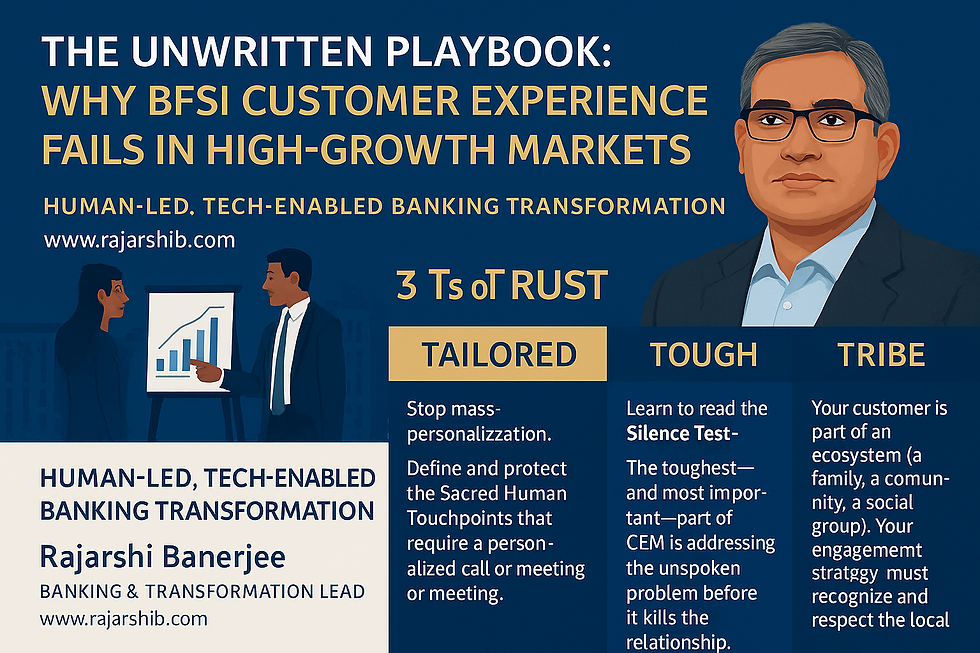
⚖️ The 3Ts of Trust: A Human Playbook for BFSI
If you want to fix customer experience in high-growth markets, skip the buzzwords. Focus on Trust—earned through time, context, and culture.
T | Definition | Example |
Tailored | Define sacred human touchpoints that must remain personal | Annual portfolio reviews, SME credit discussions |
Tough | Confront unspoken client issues early; silence is the real red flag | Proactive outreach before complaints |
Tribe | Acknowledge and empower the local community in your CX model | Partner with local leaders or agents for accountability |
✨ The Unwritten Truth
The best customer experience isn’t the one with the most data—it’s the one with the most empathy. In India and Africa, the winning strategy will always be human-led, technology-enabled.
💭 Your Turn
I’m building a crowdsourced CEM Playbook for 2025—real stories from leaders who’ve faced these challenges on the ground.
👉 What’s one lesson you’ve learned about earning trust—beyond data and dashboards? Drop your thoughts below or write to me via www.rajarshib.com.


Comments